Quick Links
Contact Us
Borak Unique Heights, Eskaton Garden, 117 Kazi Nazrul Islam Ave, Dhaka 1217

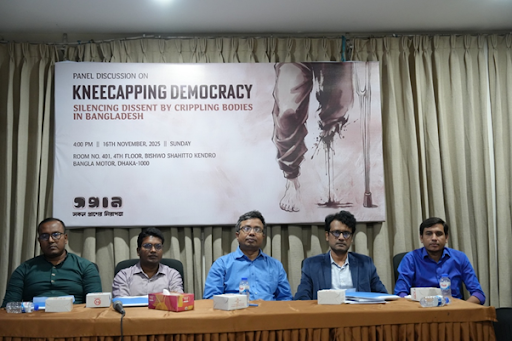
Kneecapping Democracy: Silencing Dissent by Crippling Bodies in Bangladesh
Room no: 401
Bishwo Shahitto Kendro, Bangla Motor, Dhaka
A panel discussion titled “Kneecapping Democracy: Silencing Dissent by Crippling Bodies in Bangladesh” at Room 401 of the Bishwo Shahitto Kendro, Bangla Motor, Dhaka was held on 16 November, 2025. The discussion highlighted how, over the past 15 years, the Awami League government systematically used law enforcement agencies to kneecap (shoot at the knees) political opponents in order to cripple them and suppress dissent.
The event began with a presentation by human rights activist Moshfiqur Rahman Johan on behalf of Sapran. Through a photographic exhibition, he illustrated the experiences of kneecapping victims and the forms of torture inflicted on them. He also discussed media framing during that period and the victims’ ongoing suffering.
Following this, Sapran researcher Nusrat Jahan Nisu delivered a theoretical and legal analysis based on her research paper titled “Living Through the Wound: ‘Kneecapping’—A Systematic Erasure of Political Dissent in Bangladesh.” She explained how the Awami League’s fascistic politics, the politicization of law enforcement agencies, negligence by sections of the medical community, questionable roles of the media, and—most critically—the unethical support of the administration and the judiciary collectively enabled such barbaric human rights violations.
Kneecapping survivor Md. Lemon Hossen then shared his story. He recounted the torture he endured at the hands of law enforcement, the negligence of doctors, and the state-imposed cases and harassment he faced. Reliving his traumatic ordeal, he said, “At moments I felt that if they had shot me in the head instead of the leg, perhaps I would not have had to live through this.”
Another kneecapping survivor, Samsul Alam Bulbul, also described his experience and detailed the brutal torture inflicted on him by law enforcement. Reflecting on the human rights abuses committed during the previous authoritarian regime, he said, “May the state never again turn into a killer. No one should have to become disabled like me to serve the political interests of any party.”
Investigative journalist Sohel Rana spoke about his field-level findings on kneecapping. He described how law enforcement orchestrated staged “gunfights” to cripple political opponents of the Awami League. He also explained how fabricated testimonies and false cases were used to socially and economically isolate the victims.
Professor Dr. Mohammad Mahbubur Rahman of the Department of Law, University of Dhaka, described how the authoritarian state apparatus sustained kneecapping over the past 15 years through a culture of fear. He added that since independence, political leaders have cultivated hatred instead of collective nation-building. Unless the country can move away from this trajectory, he warned, the nation may face even greater violence. He called for impartial investigations into each incident of kneecapping and for justice against all responsible persons.
Press Institute of Bangladesh Director General Faruk Wasif, in his remarks, explained how the Awami League deepened divisions within society through politics of vengeance and, with the help of opportunistic intellectuals and servile media, dehumanized political opponents—creating conditions in which grave human rights violations like kneecapping became possible. He emphasized the need to break away from this culture of vengeance and to uphold accountability and social reform in the future.
At the conclusion of the event, Md. Zarif Rahman, Research Director of Sapran, delivered the closing remarks. He underscored the need for further research on human rights violations such as kneecapping so that these incidents remain alive in the collective memory of the people. Such remembrance, he noted, will make it harder for future governments to repeat these violations. The discussion was moderated by Sapran researcher Zeba Sajida Saraf.”
14 February 2025
20 March 2025
10 April 2025